
The World War That Almost Started Over a Pig (Pig War)
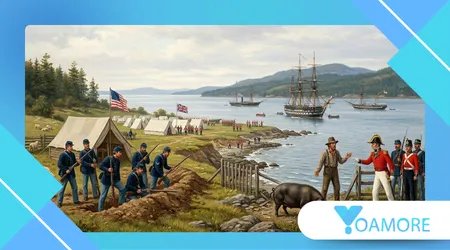
Der World War That Almost Started Over a Pig serves as a masterclass in how poor communication and rigid boundaries can escalate minor disputes into international crises.
Anzeigen
Historical friction between the United States and Great Britain reached a boiling point in 1859 on San Juan Island, located between Washington Territory and Vancouver Island.
This unusual confrontation highlights the importance of conflict resolution, a skill just as vital for modern digital professionals as it was for nineteenth-century diplomats.
Summary of Insights
- The Catalyst: A simple garden trespass by a Berkshire boar.
- Military Escalation: How thousands of soldiers were deployed over a single livestock casualty.
- Resolution Strategies: The transition from aggressive posturing to a peaceful, decade-long joint occupation.
- Professional Lessons: Applying historical crisis management to today’s remote work environments.
What is the Pig War of 1859?
The Pig War was a non-lethal confrontation between the United States and the British Empire over the sovereignty of the San Juan Islands.
Ambiguous wording in the Oregon Treaty of 1846 left the water boundary undefined, leading both nations to claim the fertile archipelago.
Anzeigen
Tensions remained quiet until June 15, 1859, when an American farmer named Lyman Cutlar shot a pig belonging to the Hudson’s Bay Company.
When British authorities threatened to arrest Cutlar, the American military intervened, sparking a standoff that lasted for several months.
Why Did a Single Pig Nearly Cause an International Conflict?
Geopolitics often hinges on perceived disrespect rather than the actual value of the resources at stake during a localized dispute.
The British viewed the shooting as a criminal act against a Crown-chartered company, while Americans saw the threat of arrest as a violation of sovereignty.
Captain George Pickett, who later gained fame in the American Civil War, was dispatched with a company of soldiers to protect American interests.
His defiant stance forced the British to send three warships, effectively turning a backyard squabble into a high-stakes military blockade.
How Did the Military Escalation Progress on San Juan Island?
By August 1859, the situation transitioned from a local disagreement into a massive display of naval and infantry power.
The Americans had nearly 500 soldiers entrenched on the island, while the British fleet boasted five warships and over 2,000 men.
Despite the overwhelming firepower, both sides received strict orders to avoid firing the first shot, preventing the World War That Almost Started Over a Pig from becoming a bloody reality.
This period of “armed “watchfulness” demonstrates how restraint can prevent catastrophic failures when emotions and national pride run high.
++ Die wahre Geschichte der Ludditen: Mehr als nur Anti-Technologie
Which Leaders Intervened to De-escalate the Situation?
President James Buchanan eventually realized that a war with Great Britain over a pig would be a diplomatic disaster for his administration.
He dispatched General Winfield Scott, a seasoned negotiator, to meet with Governor James Douglas and find a middle ground.
Scott proposed a “Joint Occupation,” where both nations would maintain a small military presence on opposite ends of the island. This sensible compromise reduced immediate tensions and allowed the two global powers to focus on more pressing domestic and international concerns.
++ Das afrikanische Reich von Mali und sein goldreicher Kaiser
Comparative Data of the Pig War Standoff
| Besonderheit | United States Forces | British Imperial Forces |
| Initial Personnel | 66 Soldiers | 3 Warships (initially) |
| Peak Personnel | 461 Soldiers | 2,140 Sailors and Marines |
| Artillerie | 14 Cannons | 167 Naval Guns |
| Casualties | 1 Pig | 0 |
What Role Did the German Emperor Play in the Final Settlement?

The joint occupation of San Juan Island lasted for twelve years, surviving the duration of the American Civil War.
In 1871, both nations agreed to submit the boundary dispute to an impartial international arbitrator to reach a permanent solution.
Kaiser Wilhelm I of Germany headed the commission that reviewed the geographical and historical claims of both the British and Americans.
You can explore the official history of the San Juan Island National Historical Park to see the detailed maps used during this arbitration.
How Was the Boundary Dispute Finally Resolved in 1872?
The German commission ruled in favor of the United States, concluding that the Haro Strait was the intended boundary.
This decision granted the San Juan Islands to Washington Territory, ending the British presence and the threat of future conflict.
British Marines withdrew from their “English Camp” in October 1872, followed by the American withdrawal from “American Camp” shortly after.
This peaceful conclusion solidified the border between the two nations, which remains the longest undefended border in the world today.
What Are the Professional Lessons from This Historical Event?
Modern freelancers and remote workers can learn much from the World War That Almost Started Over a Pig regarding boundary setting.
Misunderstandings in contracts or project scopes often mirror the ambiguous wording of the 1846 treaty, leading to unnecessary professional friction.
Learning to de-escalate when a “metaphorical pig” is shot in a project ensures that minor errors do not destroy long-term client relationships.
Taking a step back to negotiate, rather than reacting with defensive posturing, is a hallmark of a sustainable and mature career.
++Der Tag, an dem der Mississippi rückwärts floss
Why Does This Event Matter to Digital Professionals in 2026?
In our hyper-connected world, a single misunderstood email or a Slack message can escalate into a “war” of words. The Pig War teaches us that the cost of conflict often outweighs the value of being “right” in the moment.
Authentic communication and third-party arbitration are tools that save businesses thousands of dollars and countless hours of wasted productivity.
By studying these forgotten historical events, we gain a broader perspective on problem-solving and the necessity of patience in our daily professional lives.
Abschluss
The Pig War remains one of the most curious episodes in history, proving that peace is often a choice made through deliberate restraint.
While it began with a dead boar and ended with a German Emperor’s decree, its legacy is one of successful diplomacy.
For digital professionals, it serves as a reminder to define boundaries clearly and resolve disputes with logic rather than ego.
Häufig gestellte Fragen
Who actually owned the pig?
The pig belonged to Charles Griffin, an Englishman who managed a sheep farm for the Hudson’s Bay Company on the island.
Was anyone ever injured during the Pig War?
No humans were killed or injured; the only casualty of the entire thirteen-year standoff was the original Berkshire boar that started it.
Can you visit the site of the Pig War today?
Yes, the San Juan Island National Historical Park preserves both the American and English camps, offering tours that detail the unique joint occupation.
How did the soldiers spend their time during the 12-year occupation?
Reports indicate the soldiers lived quite peacefully, often visiting each other’s camps to celebrate holidays, share supplies, and hold athletic competitions.
What was the final cost of the Pig War?
While the pig was valued at $10, the military buildup and decade-long occupation cost both governments thousands of pounds and dollars in logistics.