Kublai Khan commanded an empire stretching from Eastern Europe to the Pacific, yet his war machine broke apart in the humid jungles of Southeast Asia during 1293.
Oglasi
Pažljivo gledajući Mongolska invazija na Javu - spominjanje u nekoliko povijesnih knjiga exposes a fascinating blind spot in global history—one where local geopolitical cunning dismantled an empire people assumed was invincible.
Western classrooms spend weeks dissecting Mongol failures in Japan during 1274 and 1281, while skipping over this massive maritime disaster across the Java Sea.
That omission misses the real story.
Beneath those dusty Yuan annals lies a masterclass in asymmetric warfare, spoiled logistics, and diplomatic deception that redrew the map of Indonesia for centuries.
Oglasi
By tracing why Kublai Khan risked a thousand-ship armada, how Prince Raden Wijaya baited seasoned Mongol generals into fighting his own civil war, and how the Majapahit Empire rose from the wreckage, we get a sharper picture of how empires actually fall.
Article Summary:
- Diplomatic Trigger: King Kertanegara mutilated a Yuan envoy in 1289, provoking Kublai Khan’s punitive naval expedition.
- Military Scale: Between 20,000 and 30,000 Yuan soldiers sailed across unfamiliar equatorial waters in late 1292.
- Strategic Betrayal: Javanese Prince Raden Wijaya used Mongol troops to destroy his domestic rival before turning on the invaders.
- Lasting Legacy: This unexpected defeat accelerated Yuan maritime decline and sparked the golden age of the Majapahit Empire.
Što je pokrenulo mongolsku ekspediciju na Javu 1293. godine?

Pride—specifically the dangerous collision of two rulers who refused to blink—lit the fuse across the South China Sea.
King Kertanegara of Singhasari spent the late thirteenth century aggressively expanding Javanese influence across the archipelago, stepping directly on Yuan Dynasty tributary toes.
When Kublai Khan dispatched envoy Meng Qi to Java in 1289 to demand formal submission, he expected compliance.
Kertanegara answered differently: he branded the ambassador’s face with a hot iron, sliced off his ears, and put him back on a boat to China.
There is something unsettling about how personal humiliation so often dictates imperial bloodletting.
Enraged by the insult, Kublai Khan ordered governors in Fujian, Jiangxi, and Huguang to assemble a punitive fleet—an expensive gamble driven less by trade strategy than by bruised royal ego.
Proučavanje Mongolska invazija na Javu - spominjanje u nekoliko povijesnih knjiga reminds us that superpowers rarely stumble because they lack strength; they stumble when pride clouds their judgment.
Ironically, the target vanished before the ships even left port.
Duke Jayakatwang of neighboring Kediri rebelled against Singhasari and killed King Kertanegara in 1292, leaving Yuan commanders sailing blindly toward Java to punish a dead man.
+ Izgubljena ekspedicija koja je slučajno prekrojila nacionalne granice
How Massive Was Kublai Khan’s Naval Armada?
Imperial shipyards hammered together roughly 1,000 flat-bottomed vessels built to haul cavalry horses, siege engines, and rations across thousands of miles of open sea.
Somewhere between 20,000 and 30,000 soldiers crowded onto those decks at Quanzhou harbor in late 1292.
Kublai Khan split authority among three veteran officers—Shi Bi in overall command, Ike Mese handling navigation, and Gao Xing leading ground infantry—a divided chain of command that bred friction the moment tropical storms battered their convoy near Champa and Billiton Island.
Months at sea rotted rations, fouled drinking water, and broke down warhorses bred for arid Central Asian steppes rather than suffocating equatorial heat.
By the time troops waded ashore near Tuban on Java’s northern coast in early 1293, dysentery and exhaustion had already done half the defenders’ work.
+ Bitka za Atenu: Kada su veterani Drugog svjetskog rata ponovno osvojili grad
| Campaign Metric | Yuan Dynasty Invasion Force | Javanese Defenders (Raden Wijaya) |
| Glavni zapovjednici | Shi Bi, Ike Mese, Gao Xing | Raden Wijaya, Arya Wiraraja |
| Procijenjena snaga trupa | 20,000 – 30,000 soldiers | ~10,000 – 15,000 irregular fighters |
| Naval Fleet Size | ~1,000 transport and war junks | Small coastal outrigger vessels |
| Primary Combat Doctrine | Heavy cavalry, composite bows, siege warfare | Jungle ambushes, riverine mobility, deception |
| Campaign Duration | Roughly 4 months on Javanese soil | Continuous local resistance and attrition |
| Strategic Outcome | Forced withdrawal; over 3,000 elite troops killed | Founding of the Majapahit Empire (1293) |
Why Did Raden Wijaya Ally With the Invaders?
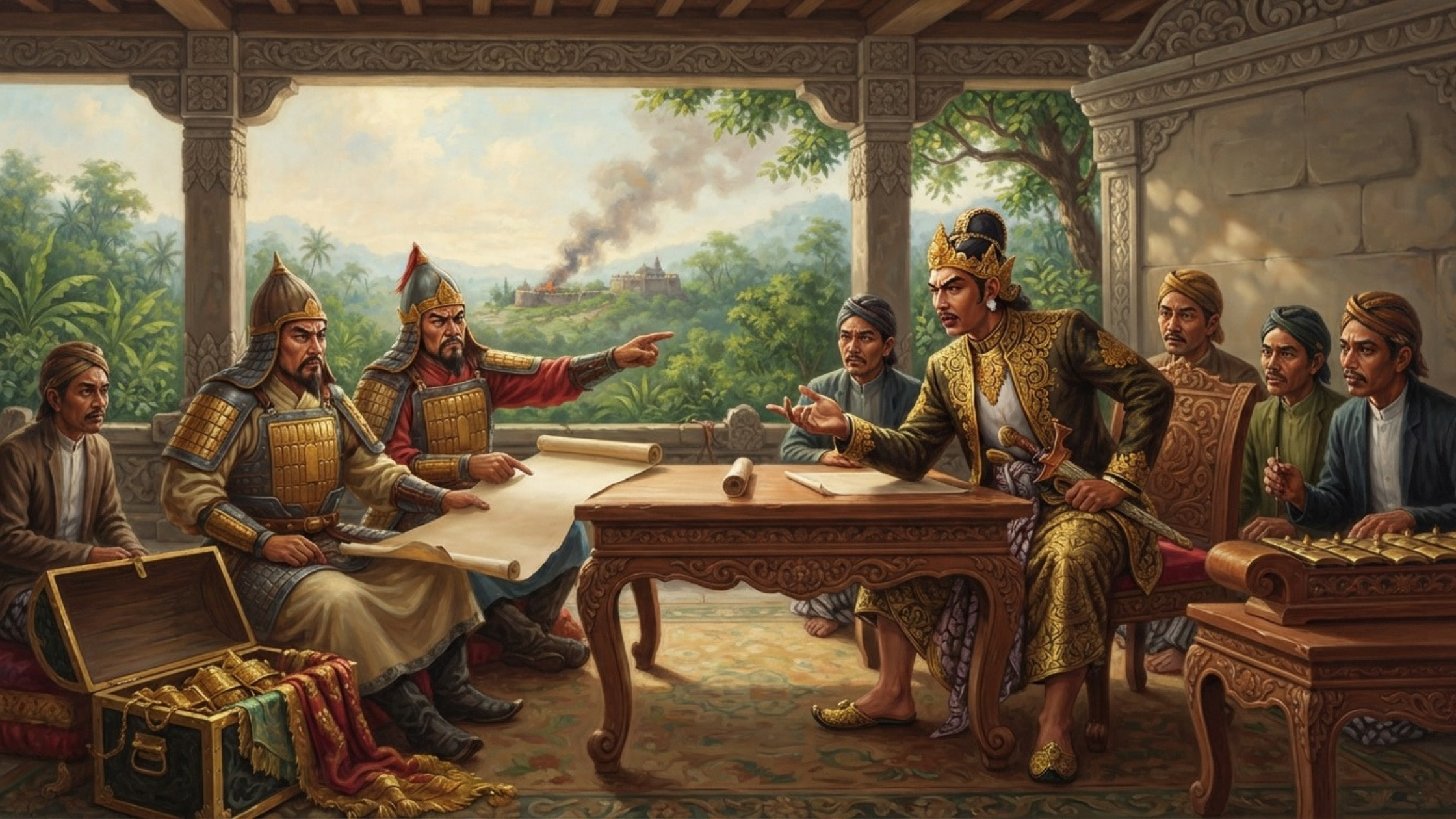
Kertanegara’s surviving son-in-law, Prince Raden Wijaya, was cornered in the forests of Trowulan with too few men to challenge usurper Jayakatwang alone.
Seeing Mongol sails on the horizon, he made a cold calculation: instead of fighting the foreigners, he would rent their army.
Wijaya sent envoys offering nominal submission alongside maps and intelligence on Kediri’s defenses, knowing Yuan generals were desperate for local guides through Java’s tangled river deltas.
Archival translations from the History of Yuan cited in Encyclopaedia Britannica’s overview of the Majapahit Empire show just how easily Wijaya fed their overconfidence.
Joint Yuan and Javanese columns marched inland toward Daha, Jayakatwang’s fortified capital, shattering Kediri’s lines after brutal river clashes in April 1293.
Jayakatwang laid down his arms before Shi Bi, assuming surrender to a foreign empire would buy mercy.
In a matter of weeks, Mongol commanders bled their own ranks dry in tropical heat to eliminate Wijaya’s chief domestic rival for him.
Ispitivanje Mongolska invazija na Javu - spominjanje u nekoliko povijesnih knjiga reveals a timeless tactical truth: patience and misdirection often outperform brute force on unfamiliar ground.
How Did Javanese Forces Defeat the Yuan Army?
With Jayakatwang locked in Mongol custody, Raden Wijaya politely asked permission to return to Majapahit under a light escort so he could gather royal tribute for Kublai Khan.
Eager to pack treasure chests before monsoon winds shifted, Shi Bi and Ike Mese signed off on the request without a second thought.
That mistake cost them the war.
Wijaya’s hidden fighters ambushed and wiped out the unsuspecting escort, then sealed off narrow forest trails across East Java while poisoning wells and severing supply routes back to the coast.
Stranded in scattered camps without cavalry mobility, Yuan infantry faced nightly guerrilla raids from blowguns, spears, and flaming arrows out of the dark.
Gao Xing barely hacked his way back to the shoreline, leaving more than 3,000 veteran troops dead along the jungle paths.
Facing total entrapment once seasonal winds reversed, Shi Bi executed Jayakatwang and ordered a frantic evacuation in May 1293—only to return to Beijing where an enraged Kublai Khan stripped him and Ike Mese of their property and ordered public lashings.
What Lasting Impact Did This Forgotten Victory Have?
Outsmarting Asia’s greatest military superpower turned Raden Wijaya overnight into an untouchable monarch, allowing him to take the throne as King Kertarajasa Jayawardhana.
Under his dynasty, the Majapahit Empire grew into a maritime powerhouse controlling vital spice routes across modern Indonesia, Malaysia, and Singapore.
For Beijing, the disaster drained imperial coffers and punctured the aura of Mongol invincibility across Southeast Asian courts.
Rulers from Sumatra to Vietnam took quiet note that monsoon calendars, dense terrain, and sharp diplomacy could bring a Chinese armada to its knees.
Historians who dig into the Mongol Invasion of Java Few History Books Mention see 1293 as a genuine hinge point in Asian geopolitics.
Instead of becoming a tributary province, Java launched a cultural and architectural golden age whose influence still anchors Indonesian identity.
+ Kako je Operacija Cottage postala najčudnija saveznička invazija u Drugom svjetskom ratu
Why Do Western History Books Overlook Java 1293?
This campaign is routinely misunderstood—or simply ignored—because traditional Western curricula orbit around battles that brushed Europe, the Middle East, or Japan’s famous samurai ethos.
Because Java sat outside Mediterranean and Northeast Asian narratives, classical Javanese chronicles like the Pararaton i Nagarakretagama went largely untranslated for generations.
Bridging Classical Chinese imperial records with Old Javanese court poetry took centuries of slow linguistic detective work.
Ongoing archaeological findings documented in UNESCO’s Trowulan Majapahit Heritage dossier continue to unearth the urban footprint of the kingdom that held off Kublai Khan.
Reclaiming the Mongolska invazija na Javu - spominjanje u nekoliko povijesnih knjiga does more than fill a footnote; it forces us to look beyond familiar maps and recognize how decisive Southeast Asian statecraft truly was.
Često postavljana pitanja (FAQ)
When did the Mongol invasion of Java happen? Kublai Khan’s fleet departed southern China in late 1292, and active military campaigns on Javanese soil lasted from early 1293 until May 1293.
Who led the Javanese resistance against the Mongols? Prince Raden Wijaya orchestrated the resistance, initially feigning alliance with Yuan commanders to defeat a domestic rival before ambushing and expelling the Mongol forces.
How many soldiers did Kublai Khan send to Java? Imperial records in the History of Yuan indicate that roughly 20,000 to 30,000 soldiers sailed aboard approximately 1,000 ships from Quanzhou.
What empire emerged in Java after defeating the Mongols? Raden Wijaya established the Majapahit Empire in late 1293, which expanded into the largest and wealthiest pre-colonial maritime empire in Southeast Asia.