The Rise of Ambient Media and Passive Consumption
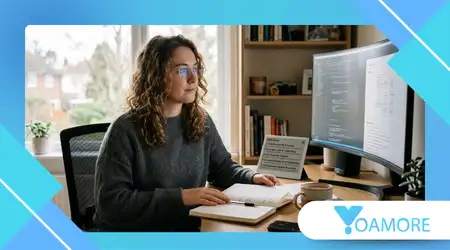
The Rise of Ambient Media and Passive Consumption marks a profound shift in the psychological architecture of the remote workspace, moving beyond simple background noise into a curated layer of digital consciousness.
Anúncios
In 2026, the silence of a home office is rarely silent. We have traded the erratic clatter of corporate cubicles for a steady, algorithmic hum designed to fill the void of isolation without demanding the toll of active attention.
Navigating this “always-on” environment requires more than just a good pair of headphones; it demands a strategic understanding of how peripheral information shapes our cognitive endurance and professional output.
Summary of Key Insights
- Deconstructing the “Digital Wallpaper” of the 2026 landscape.
- The hidden cognitive tax of low-friction information streams.
- Curating an auditory and visual “moat” around deep work.
- Data-driven shifts in how platforms capture idle attention.
- Finding the threshold between companionship and distraction.
What is the Rise of Ambient Media and Passive Consumption?
Ambient media has evolved into a form of digital architecture. It is the content that lives in your periphery—the 12-hour Lo-Fi stream, the data dashboard on a smart glass, or the spatial audio “office” that replicates a London café in your bedroom.
This isn’t media you “watch” or “read” in the traditional sense. It is media you inhabit. It provides a rhythmic consistency that anchors the wandering mind during repetitive tasks, acting as a sensory buffer against the chaos of domestic life.
Anúncios
Passive consumption is the act of existing alongside this data. While it feels effortless, there is something subtle happening beneath the surface: we are training our brains to process a dual-layer reality where the primary task and the background stream coexist.
Understanding the Rise of Ambient Media and Passive Consumption is essential because, left unchecked, this “background” can slowly migrate to the foreground, eroding the very focus it was meant to protect.
How Does Passive Consumption Affect Freelancer Productivity?
For the solo professional, ambient media serves as a “body double”—a psychological hack that tricks the brain into feeling part of a collective effort. This often lowers the barrier to starting difficult, solitary projects.
However, the industry frequently misinterprets this as a free lunch. Every stream, no matter how “low-stakes,” occupies a sliver of your working memory, which can lead to a strange, hollow fatigue by the end of a session.
The most effective remote workers treat their ambient environment like a thermostat. They turn the “information density” up during low-brainpower tasks and dial it back to near-zero when the work demands absolute, creative synthesis.
True productivity in this era isn’t about total silence; it’s about the deliberate calibration of noise. It’s the difference between a curated focus-scape and a chaotic sprawl of YouTube tabs that eventually lead to a rabbit hole.
Why Are Tech Platforms Prioritizing Background Content in 2026?
Platform engineering has pivoted from the “attention economy” to the “presence economy.” Since there are only so many hours a user can actively click, companies now compete to be the software you never close.
By designing content that thrives in the background—think long-form video essays or generative soundscapes—platforms secure a permanent seat at your desk. They become the “wallpaper” of your professional life, building brand loyalty through osmosis.
This shift reflects a cynical but brilliant realization: it is easier to keep a user “near” an app for eight hours of passive use than to fight for ten minutes of their undivided, active attention.
The Rise of Ambient Media and Passive Consumption is essentially a land grab for the idle corners of our minds, turning our moments of quiet reflection into subsidized data streams for the major tech ecosystems.
++ Why Aesthetic Labels Replaced Subcultures
Comparative Impact of Media Consumption Types
| Media Architecture | Cognitive Load | Ideal Professional Context | 2026 Adoption |
| Active Video | Critical/High | Learning a new software | 12% |
| Ambient Audio | Subliminal | Routine coding/Admin | 45% |
| Glanceable UI | Intermittent | Real-time market tracking | 38% |
| Immersive Sound | Environmental | Deep flow/High stress | 22% |
Which Tools Support a Healthy Ambient Media Strategy?
The hardware of 2026 has caught up to our need for “glanceable” information. Secondary e-ink displays and smart desk-tickers allow us to monitor industry pulses without the dopamine-spike of a smartphone notification.
Specialized services like Deep Work Audio have moved beyond simple nature sounds, using AI to generate non-repetitive acoustic patterns that actively prevent the brain from habituating and drifting off-task.
Integrating these tools requires a “set it and forget it” mindset. If you are constantly fiddling with the playlist or adjusting the stream, the media has failed its primary purpose: it has become an active distraction.
The goal is to build a sensory “moat.” A well-curated ambient setup should disappear into the room, leaving you with nothing but the momentum required to finish your most demanding freelance deliverables.
What Are the Risks of Over-Relying on Passive Information?
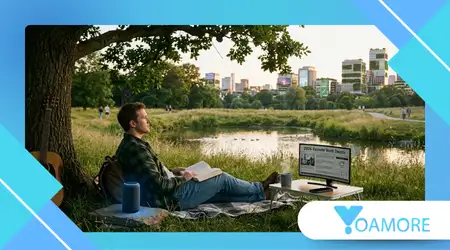
There is a growing “illusion of knowledge” among digital professionals. Just because you have “listened” to twenty hours of industry podcasts in the background doesn’t mean you have synthesized that information into a usable skill.
Passive consumption offers the comfort of learning without the friction of thinking. This can lead to a stagnant career where you are “informed” about everything but have mastered nothing of significant value.
Over-reliance on background noise also kills the “Default Mode Network”—the brain state where original ideas are born. If every silent moment is filled with an ambient stream, you lose the ability to hear your own creative voice.
The Rise of Ambient Media and Passive Consumption can be a sanctuary for the lonely worker, but it can also become a cage of “white noise” that prevents the deep, uncomfortable thinking necessary for true innovation.
++ The Globalization of Humor and the Death of Local Jokes
When Should You Transition from Passive to Active Engagement?
The pivot must be intentional. When a background stream mentions a concept that challenges your current workflow, the ambient mode should be terminated immediately to make room for active, high-resolution analysis.
Passive streams are for “grazing”—gathering broad context and maintaining a mood. Active engagement is for “hunting”—extracting specific data and applying it to your client projects or business strategy.
If you find yourself nodding along to a speaker while your hands are busy with email, you are in a passive state. To actually improve, you must stop the email, grab a notebook, and engage.
Hybrid learning is the superpower of the 2026 freelancer. Use ambient media to discover what you don’t know, then schedule “deep-dive” sessions to turn that surface-level awareness into professional expertise.
How Can Remote Workers Curate Better Ambient Environments?
Stop letting algorithms dictate your background. Most “work playlists” are designed for mass appeal, not for your specific neurological needs. Experiment with different frequencies—brown noise, pink noise, or even silence—to see what truly sustains your focus.
Consider the “Visual Ambient” as well. A secondary monitor displaying a high-resolution, slow-moving drone shot of a forest can provide a sense of space and calm that a blank wall or a cluttered desktop cannot.
Restrict passive inputs to a single sensory channel. If your work is visual, use audio streams. If your work is data-heavy and quiet, perhaps a visual ambient stream on a side tablet is the better companion.
The Rise of Ambient Media and Passive Consumption doesn’t have to be a drain on your intellect. With a little curation, it becomes a powerful atmospheric tool that turns a solitary home office into a high-performance studio.
+ How Gen Alpha Is Redefining Childhood Culture
Reflective Conclusion
The digital professional of 2026 is no longer just a worker; they are a curator of their own reality. Ambient media offers a way to soften the edges of the remote experience, provided we don’t lose ourselves in the static.
By treating our attention as a finite resource, we can use these background streams to build a more resilient, less isolated career. Use the noise to your advantage, but always leave enough room for the silence where your best work actually lives.
To explore more about protecting your focus in a distracted world, visit the Freelancers Union, where the modern workforce gathers to share strategies for a sustainable digital life.
FAQ (Frequently Asked Questions)
1. Does ambient media contribute to burnout?
It can. If the brain never experiences true sensory “quiet,” it remains in a state of low-level arousal. It’s vital to have periods of total digital silence to allow the nervous system to reset.
2. What is the best type of noise for deep focus?
Most research suggests that “non-lyrical” sounds—such as classical music, ambient electronics, or nature sounds—are best, as they don’t trigger the brain’s language-processing centers which are needed for writing or coding.
3. How can I tell if a stream is “passive” or “distracting”?
A simple test: if you can’t remember what happened in the stream five minutes ago because you were so deep in your work, it is successful ambient media. If you remember the media but forgot your work, it’s a distraction.
4. Is passive consumption “lazy” learning?
It isn’t lazy; it’s just incomplete. It’s an excellent way to maintain a pulse on your industry, but it should never replace the focused, active labor of skill acquisition and critical thinking.