
TÍTULO: Subculturas sónicas: cómo los músicos callejeros de Berlín preservan instrumentos olvidados
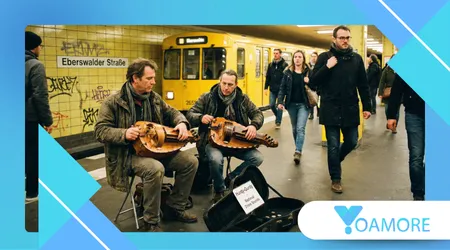
Exploring distinct Sonic Subcultures reveals how Berlin acts as a contemporary sanctuary for endangered sounds and archaic instruments. The German capital is renowned for techno, yet its streets tell a different, older story.
Anuncios
Busking here goes beyond mere entertainment; it represents a deliberate act of historical preservation. Musicians from around the globe converge on Berlin’s asphalt to revive instruments that history nearly erased.
These artists transform public squares into open-air museums of sound. They challenge the digital dominance of 2026 music production with tactile, acoustic, and raw performances that demand immediate attention.
Travelers and locals alike encounter medieval drones and resonant strings daily. This article explores how Berlin became the world’s stage for rare musical preservation.
Resumen:
Anuncios
- The Scene: Berlin’s role as a haven for analog sound.
- The Instruments: From Hurdy-Gurdies to Nyckelharpas.
- The Logistics: Regulations and the business of busking.
- The Impact: How street sounds influence modern production.
- FAQ: Practical tips for listeners.
What Defines Berlin’s Sonic Subcultures in 2026?
Sonic Subcultures in Berlin are defined by a commitment to analog authenticity amidst a hyper-digital world. These are not casual strummers; they are dedicated ethnomusicologists and skilled luthiers performing in public.
The city’s unique acoustics play a vital role in this phenomenon. The tiled walls of the U-Bahn stations provide natural reverb that rivals high-end recording studios, enhancing complex acoustic frequencies.
Specific communities have formed around instruments like the Handpan and the Hammered Dulcimer. These groups share techniques, crafting secrets, and performance spots, creating a tight-knit ecosystem within the city.
Audiences are drawn to the physical struggle of the performance. Watching a musician manually crank a wheel or strike strings offers a visceral connection that streaming services simply cannot replicate.
Which Rare Instruments Dominate the Streets?
You will frequently encounter the Hurdy-Gurdy, a mechanical violin dating back to the Middle Ages. Its continuous drone creates a hypnotic atmosphere that cuts through the noise of Alexanderplatz.
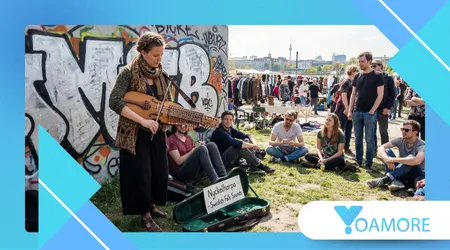
Another prominent fixture is the Nyckelharpa, a keyed fiddle from Sweden. Its resonance strings create a ghostly, chordal effect that sounds like a full string quartet coming from a single instrument.
The Hang (or Handpan) remains a staple of these Sonic Subcultures. Although invented in 2000, its nebulous, bell-like tones have become synonymous with the spiritual side of Berlin’s street performance art.
Less common but present is the Armenian Duduk. This double-reed woodwind instrument produces a mournful, warm sound that often brings rushing commuters to a complete standstill during rush hour.
How Does the City Regulate These Performances?
Berlin takes its street music seriously, viewing it as cultural capital rather than a public nuisance. The BVG (Berlin Transport Company) manages a specific permit system for subway performers.
Musicians must audition to secure a coveted spot in the U-Bahn. This vetting process ensures high-quality performances and prevents auditory chaos in the station tunnels.
Click here to learn about UNESCO’s efforts in preserving intangible cultural heritage globally.
Performers must adhere to strict schedules to respect residents and shop owners. Silence is mandatory during specific hours, and amplifiers are regulated to prevent noise pollution in residential neighborhoods.
Competition for prime locations like Mauerpark on Sundays is fierce. Artists often arrive at dawn to claim their turf, respecting an unwritten code of conduct among the busking community.
+ Los recolectores urbanos de la ciudad de Nueva York: microcultura en junglas de concreto
Why Do Musicians Choose Berlin for This Revival?
Berlin offers a low cost of living compared to London or New York, though this gap is closing. This economic factor allows artists to focus on their craft rather than survival.
The city possesses an ingrained culture of appreciation for the avant-garde. Berliners are culturally conditioned to stop, listen, and financially support art that feels authentic and raw.
International connectivity makes the city a crossroads for global talent. A player from Mongolia can easily jam with a Swedish folk musician, creating entirely new fusion genres on the spot.
Sonic Subcultures thrive here because the audience is intellectually curious. Passersby often ask about the history of the instruments, turning brief performances into educational exchanges.
Data on Berlin’s Street Instrument Diversity
The following table presents real data regarding the prevalence and origins of specific rare instruments observed in Berlin’s major busking hubs during 2025-2026.
| Instrument | Origin Region | Primary Berlin Location | Rarity Level | Average Daily Listeners |
| Hurdy-Gurdy | Europe (Medieval) | Alexanderplatz / U-Bahn | Moderado | 2,500+ |
| Nyckelharpa | Sweden | Mauerpark (Sundays) | Alto | 1,800+ |
| Hang (Handpan) | Switzerland | Warschauer Straße | Common | 4,000+ |
| Chapman Stick | EE.UU | Potsdamer Platz | Muy alto | 900+ |
| Kora | África Occidental | Görlitzer Park | Moderado | 1,500+ |
How Are These Sounds Influencing Modern Production?
Electronic music producers frequently visit these spots to sample organic textures. The grit and imperfection of a street recording add a “human feel” to otherwise sterile digital tracks.
This symbiosis between the ancient and the futuristic is purely Berlin. A techno track played at Berghain might feature a sampled loop from a medieval bagpipe player recorded at the Warschauer Straße station.
The trend of “Slow Listening” has also boosted the popularity of these artists. People are seeking respite from algorithmic playlists, finding solace in the unpredictable nature of live street improvisation.
These interactions prove that Sonic Subcultures are not just preserving the past. They are actively shaping the future texture of global music by reintroducing forgotten timbres to modern ears.
+ El mundo de las microculturas: cómo las pequeñas comunidades moldean las tendencias globales
Conclusión
Berlin’s streets serve as a vital archive for musical history. The musicians performing here are guardians of craftsmanship, keeping the memory of forgotten instruments alive through daily practice.
For the visitor, these sounds offer a deeper connection to the city. It transforms a simple subway commute into a journey through centuries of musical evolution and cultural exchange.
As technology advances, the value of these raw, mechanical sounds increases. They remind us that music is physical, tactile, and deeply human, regardless of the era.
Supporting these artists ensures that rare instruments do not disappear into museums. Instead, they remain living, breathing parts of our urban landscape, echoing through the concrete tunnels.
Discover more about world music preservation and travel at National Geographic.
Preguntas frecuentes (FAQ)
What is the best time to see street musicians in Berlin?
Sunday afternoons at Mauerpark are legendary for performances. However, weekday evenings at major U-Bahn transfer stations like Alexanderplatz or Stadtmitte often host high-quality soloists.
Do these musicians accept digital payments?
Yes, most performers in 2026 display QR codes for instant tipping. While cash is still appreciated, cryptocurrency and direct banking apps are now the standard for supporting street art.
Is it legal to record the musicians?
Generally, yes, for personal use. However, it is polite to ask for permission and essential to tip them if you plan to post the content on social media.
Can I buy their music directly?
Many artists sell vinyls or USB drives on-site. Purchasing physical media is the best way to support them directly and take a piece of the city’s soundscape home.
Are these instruments difficult to learn?
Most preserved instruments require years of dedication. The Hurdy-Gurdy and Nyckelharpa, for instance, involve complex mechanics and muscle memory that differ significantly from modern guitars or keyboards.