The Icelandic Volcano That Disrupted the World in 1783
The Icelandic Volcano That Disrupted the World in 1783 remains a terrifying lesson in planetary connectivity.
Anúncios
This catastrophic event, known locally as the Skaftáreldar, changed global climate patterns and toppled governments.
Summary
- Introduction
- What Triggered the Catastrophic Laki Eruption?
- How Did the “Laki Haze” Poison the Northern Hemisphere?
- Why Did a Volcano in Iceland Cause Famine in Egypt?
- Which European Political Events Were Influenced by the Eruption?
- What Were the “Mist Hardships” inside Iceland?
- Comparison Table: Laki vs. Other Historic Eruptions
- How Do Scientists Analyze These Events in 2025?
- Conclusion
- Frequently Asked Questions (FAQ)
What Triggered the Catastrophic Laki Eruption?
History often overlooks geological triggers, but the Laki event was unique. On June 8, 1783, the earth tore open in southern Iceland, creating a massive fissure rather than a single explosive peak.
Underground pressure from the Grímsvötn volcanic system forced magma to the surface. This geological violence created a tear in the crust extending over 27 kilometers, spewing fountains of fire into the sky.
Observers at the time described walls of lava towering over 1,000 meters high. The Icelandic Volcano That Disrupted the World in 1783 released an estimated 14 cubic kilometers of basaltic lava.
Anúncios
River valleys vanished under the molten flood within days. The heat was so intense that it dried up the Skaftá River entirely, filling the empty riverbed with rapidly flowing liquid rock.
This was not a short-lived explosion but a prolonged siege. The eruption continued for eight agonizing months, finally ceasing in February 1784, leaving a scarred landscape that remains visible today.
Contemporary geologists study these “flood basalt” events to understand planetary evolution. Such massive outpourings of lava are rare in human history, making Laki a critical case study for modern volcanology.
+ Why Some African Languages Have a Whistled Version
How Did the “Laki Haze” Poison the Northern Hemisphere?
The lava was destructive, but the gas proved lethal. The eruption released approximately 120 million tons of sulfur dioxide into the jet stream, creating a blanket of sulfuric acid aerosols.
Winds carried this toxic cloud southeast toward mainland Europe. By late June 1783, a dry, persistent fog descended upon Great Britain, France, and the Netherlands, obscuring the sun and trapping heat.
Benjamin Franklin, living in Paris, noted the phenomenon in his journals. He described a “constant fog” that could not be dissipated by the summer sun, giving the sky a terrifying bloody hue.
People described a distinct smell of burning sulfur pervading cities. Outdoor laborers suffered immensely, experiencing respiratory distress, eye irritation, and skin lesions caused by the acidic fallout raining down from the haze.
Crops withered under the acidic rain, leading to immediate agricultural panic. The sun’s rays were blocked so effectively that global temperatures dropped, disrupting weather patterns for years following the initial explosion.
This atmospheric opacity caused severe thunderstorms and hailstorms across the continent. The Icelandic Volcano That Disrupted the World in 1783 demonstrated how fragile our atmospheric balance truly is against geological forces.
+ The Forgotten War That Lasted 38 Minutes
Why Did a Volcano in Iceland Cause Famine in Egypt?
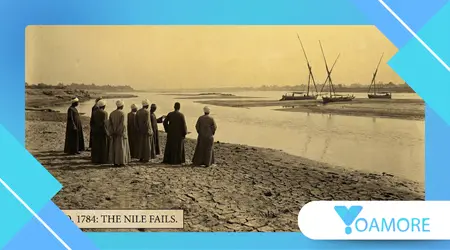
The interconnectedness of Earth’s climate became painfully obvious in 1783. The massive injection of sulfur dioxide cooled the Northern Hemisphere, which fundamentally altered the thermal gradient between land and sea.
This temperature shift disrupted the African monsoon cycle significantly. The high-pressure systems over the Atlantic pushed the rain belts southward, preventing the necessary precipitation from reaching the Ethiopian highlands.
Consequently, the Nile River failed to flood that year. Egypt relied entirely on the annual inundation to irrigate crops in the fertile valley, and without it, agriculture collapsed completely.
Historical records indicate that the resulting famine claimed one-sixth of Egypt’s population. It is a stark reminder that a geological event in the Arctic can devastate civilizations in the desert.
Traders and travelers of the era could not connect these dots immediately. It took centuries for climatologists to prove that the Laki eruption was the direct cause of this misery.
We now understand that volcanic cooling suppresses rainfall in tropical regions. This link between high-latitude eruptions and tropical droughts is a critical area of study for climate scientists in 2025.
+ The 1950s CIA Mind-Control Experiments (Project MKUltra)
Which European Political Events Were Influenced by the Eruption?
Climatic stress often acts as a catalyst for social unrest. The years following the eruption were marked by extreme weather variability in Europe, including freezing winters and poor harvest seasons.
France was particularly vulnerable during this period. The rural peasantry, already burdened by high taxes, faced starvation as wheat crops failed repeatedly due to the shortened, cold growing seasons.
The Icelandic Volcano That Disrupted the World in 1783 contributed largely to this agricultural despair. Bread prices skyrocketed in Paris, fueling the anger that eventually erupted at the Bastille in 1789.
While the volcano did not create the political ideology, it created the desperation. Hungry populations are less tolerant of inequality, and the environmental stress pushed French society toward its breaking point.
Historians today view the Laki eruption as a “force multiplier” for revolution. It exacerbated existing economic fragility, turning a difficult situation into a total societal collapse across the French countryside.
Learn more about volcanic gases and their climate effects at the U.S. Geological Survey.
What Were the “Mist Hardships” inside Iceland?
While Europe shivered, Iceland faced an apocalypse. The local population refers to this period as Móðuharðindin, or the “Mist Hardships,” marking the darkest chapter in the island’s history.
The eruption did not just spew lava; it released fluorine gas. This toxic element settled on the grass, poisoning the livestock that grazed upon it with severe dental and skeletal fluorosis.
Sheep and cattle died in agonizing droves, crippling the food supply. Approximately 80% of the sheep, 50% of the cattle, and 50% of the horses on the island perished within months.
Starvation set in rapidly for the human population. Without livestock for meat or dairy, and with coastal waters polluted by ash affecting fishing, the Icelanders had no source of sustenance.
An estimated 10,000 people died, roughly one-fifth of the population. Those who survived were forced to eat rawhide ropes and boiled skins just to stay alive during the bitter winter.
The Danish crown, which ruled Iceland, considered evacuating the entire island. The Icelandic Volcano That Disrupted the World in 1783 nearly wiped a distinct culture off the map entirely.
Comparison Table: Laki vs. Other Historic Eruptions
To understand the scale of Laki, we must compare it to other known events. The volume of lava and gas distinguishes it from explosive eruptions like Krakatoa.
| Feature | Laki (1783) | Tambora (1815) | Krakatoa (1883) |
| Type | Fissure Eruption | Stratovolcano | Stratovolcano |
| Lava Volume | ~14.7 km³ | ~50 km³ (tephra) | ~20 km³ (tephra) |
| SO2 Emission | ~120 Million Tons | ~60 Million Tons | ~20 Million Tons |
| Primary Impact | Long-term Pollution | Sudden Cooling | Shockwave/Tsunami |
| Duration | 8 Months | Days | Days |
| Global Effect | Hemispheric Haze | Year Without Summer | Temp Drop (0.4°C) |
Data compiled from historical geological records and modern climate reconstructions.
How Do Scientists Analyze These Events in 2025?
Modern technology allows us to look back with precision. Glaciologists drill ice cores in Greenland and Antarctica to measure sulfate deposits, confirming the exact timing and intensity of the Laki fallout.
Dendrochronology, the study of tree rings, supports these findings. Trees across the Northern Hemisphere show stunted growth rings for the years 1783 and 1784, proving the widespread environmental stress.
Computer modeling helps researchers simulate the gas dispersion. By inputting wind patterns and emission volumes, scientists can visualize how the haze blanketed specific regions of Europe and Asia.
The Icelandic Volcano That Disrupted the World in 1783 serves as a worst-case scenario model. Civil defense agencies use this data to plan for future fissure eruptions near populated areas.
Understanding the atmospheric chemistry of 1783 helps prediction models today. If a similar eruption occurred now, air travel across the Atlantic would likely cease for months, crippling global logistics.
Current research focuses on the resilience of modern agriculture. We must determine if our high-yield, monoculture crops could withstand the acid rain and cooling that decimated 18th-century harvests.
Conclusion
The legacy of the Laki eruption extends far beyond geology. It is a narrative of human fragility, demonstrating how a fissure in the ground can rewrite the destiny of nations.
From the starving farmers in France to the desperate islanders in the North Atlantic, millions of lives were altered by this single geological event. It unified the world in shared suffering.
We must remember the Icelandic Volcano That Disrupted the World in 1783 not just as history, but as a warning. The earth remains dynamic, and our societies are still vulnerable to its power.
Studying these forgotten events prepares us for the future. As we face modern climate challenges, the lessons from the “Mist Hardships” remain relevant, urging us to respect the planet’s volatility.
Read the historical account of the Laki eruption at Britannica.
Frequently Asked Questions (FAQ)
How long did the Laki eruption last?
The eruption began on June 8, 1783, and finally ended in February 1784. However, the resulting gas haze and climatic effects persisted for several years across the Northern Hemisphere.
Is the Laki volcano still active today?
The Laki fissures are part of the Grímsvötn volcanic system, which is Iceland’s most active system. While the specific 1783 fissures are dormant, the system itself remains highly active.
Did the eruption really cause the French Revolution?
It was a contributing factor, not the sole cause. The eruption caused crop failures and famine, which exacerbated existing economic anger and social unrest leading up to the 1789 revolution.
What was the primary cause of death in Iceland?
Most deaths were not from the lava itself. Fluorine poisoning destroyed the livestock population, leading to a massive famine that killed approximately 20-25% of the human population.
Could a Laki-style eruption happen again?
Yes, geological history suggests these events are cyclical. A similar fissure eruption in the future would have devastating effects on modern air travel, climate, and public health.