The Whispering Tongues of the Amazon: Languages Without Vowels
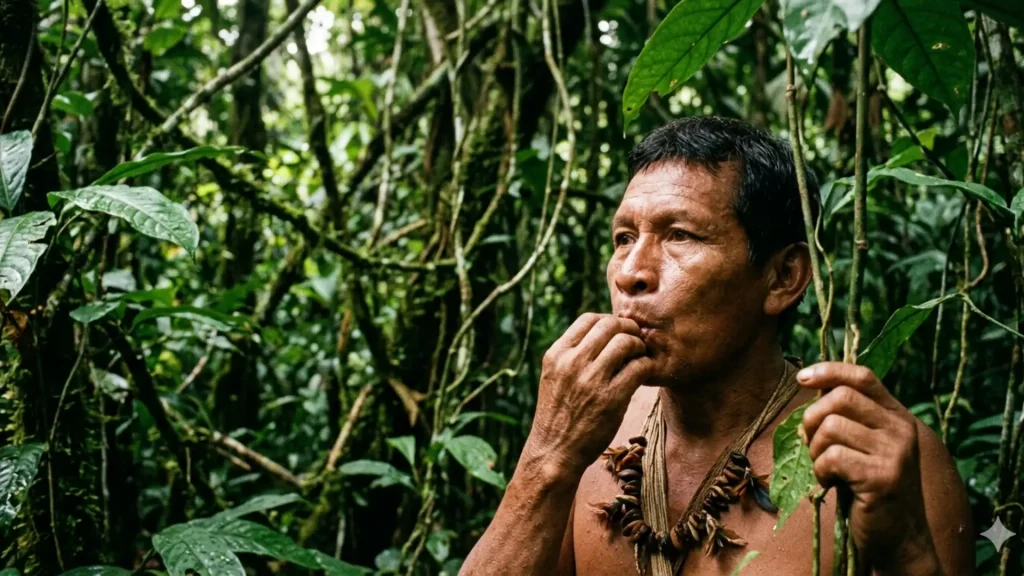
Deep in the humid corridors of the rainforest, communication has taken a sharp, tactical turn. Ancient cultures here don’t always rely on vocal cords. Instead, they use melodies and whistles to pierce through the thick canopy.
Anúncios
We are diving into how these acoustic systems breathe in 2026. You will see the raw science behind tonal survival. We also explore why these forest echoes matter for our digital future.
- The Physics of Forest Phonetics
- Pirahã: Breaking Linguistic Rules
- Global Echoes of Silent Speech
- Archiving the Invisible via Tech
What are the Whispering Tongues of the Amazon?
This isn’t about code or secret signals. It is a fundamental shift where vowels and consonants simply vanish. Speakers swap traditional articulation for high-frequency whistles, hums, or rhythmic pulses.
Think of these systems as a sophisticated “overdrive” for existing dialects. They mimic the natural rise and fall of spoken words. It’s a tool born from necessity during long hunts or river crossings.
The Whispering Tongues of the Amazon prove that speech is incredibly fluid. In a place where vision is blocked by mahogany and vines, sound must adapt. Low frequencies get swallowed by the mud; whistles cut through.
Anúncios
How Do Whistled Languages Function Without Vowels?
Whistled speech strips away the “noise” of breath and focuses on pure frequency. By removing mouth-shaped vowels, speakers isolate the core pitch. This creates a signal that remains crisp over miles.
In tonal languages, meaning lives in the height of the note. Whistlers replicate these melodies using only their lips or knuckles. The human brain then reconstructs the full sentence from just the rhythm.
Researching the Whispering Tongues of the Amazon reveals something fascinating about our grey matter. Both sides of the brain light up to decode these songs. It’s a biological masterpiece of compression and transmission.
+ Linguistic Refugees: Saving Languages Among Diasporas
Why is the Pirahã Language Historically Significant?
The Pirahã people possess a linguistic framework that baffles outsiders. Their daily talk often dissolves into “hummed speech” during tropical downpours. It is a pragmatic response to an environment that drowns out normal voices.
Linguist Daniel Everett famously highlighted how this group ignores conventional grammar rules. They prioritize the “now,” focusing on direct, witnessed experience. This philosophy is baked into every whistle and hum.
Analyzing the Whispering Tongues of the Amazon through the Pirahã lens is humbling. They don’t need abstract numbers to master their world. Their speech is a lean, mean survival machine optimized for the jungle.
Comparison of Acoustic Communication Systems (2026 Data)
| Language Group | Primary Method | Estimated Distance | Primary Use Case |
| Pirahã (Brazil) | Hum/Whistle | 1.5 Kilometers | Hunting/Rainy Weather |
| Gavião (Brazil) | Whistle/Instruments | 2.0 Kilometers | Long-distance Alerts |
| Silbo Gomero* | High-pitch Whistle | 5.0 Kilometers | Mountainous Navigation |
*Non-Amazonian reference for technical comparison.
Which Environmental Factors Shape These Languages?
The rainforest is a noisy, absorbent wall. Normal speech frequencies are quickly muffled by wet leaves and heavy air. Indigenous groups bypassed this by mimicking the piercing calls of forest birds.
Acoustic ecology isn’t just a fancy term; it’s a life-or-death design choice. Humans essentially hacked the jungle’s natural soundscape to stay connected. They found the “frequency holes” where sound travels best.
The Whispering Tongues of the Amazon show that geography dictates our internal logic. When stealth is required, the whisper becomes a weapon. When distance is the enemy, the melody becomes the bridge.
+ From Forbidden to Celebrated: The Welsh Language’s Political Journey
What are the Modern Threats to Linguistic Diversity?
Modernity often arrives as a blunt instrument. As youth move toward urban centers, Portuguese and Spanish become the default. The specialized “forest register” starts to feel like a relic of the past.
By 2026, satellite links have reached even the most remote Xingu villages. While connectivity is a win, it often flattens local nuance. Many of these tonal registers are now vanishing faster than the trees.
Saving the Whispering Tongues of the Amazon isn’t just about nostalgia. If the elders stop whistling, a specific way of human thinking disappears. We lose a cognitive map we haven’t fully explored yet.
To see how global organizations track these shifts, visit the UNESCO Atlas of the World’s Languages in Danger. Their data shows the fragility of these oral traditions.
How Can Digital Professionals Support Language Preservation?

Remote workers and tech strategists are finding clever ways to help. Some are building decentralized databases to store high-fidelity whistle recordings. These archives allow future generations to “re-tune” their ears.
Freelancers can contribute by supporting localized translation tech. AI, ironically, is being trained to recognize these non-vowel patterns. This helps keep indigenous voices relevant in a digital-first world.
The Whispering Tongues of the Amazon belong in our future, not just our history. By integrating this knowledge into new platforms, we preserve human variety. Technology should amplify the forest’s wisdom, not mute it.
+ How Translation Apps Fail Endangered Languages
Conclusion
The Amazon’s vowel-less speech is a testament to human grit. It reminds us that communication is deeper than just vocabulary. It is a rhythmic dance between the speaker and their environment.
We should treat these whistling systems with the same reverence as ancient scrolls. They contain secrets about physics and how we perceive sound. Letting them fade would be a quiet tragedy for us all.
The Whispering Tongues of the Amazon invite us to re-evaluate how we listen. In our loud, screen-heavy lives, there is much to learn from a simple whistle. Let’s make sure these voices don’t go silent.
For more on cultural sovereignty and land protection, visit Survival International. They stand at the front lines of protecting the people behind these unique voices.
FAQ: Frequently Asked Questions
Is whistling a language or just a signal?
It’s a full register. While it sounds like a signal, it follows the exact syntax and tone of the spoken dialect. It can convey complex, nuanced thoughts over long distances.
Why is it so hard for outsiders to learn?
Most western languages aren’t tonal. If you don’t grow up hearing how pitch changes a word’s meaning, your brain struggles to “hear” the sentences hidden in the whistles.
Does the Amazon have the most whistled languages?
While found in places like Turkey, the Amazonian versions are unique for their environmental integration. They are specifically tuned to the acoustic “dead zones” of the rainforest floor.